AI Content for Branding vs AI Content for Marketing: Same Tools, Completely Different Outcomes

Most teams say they are using AI for content.
Very few are using it to make money.
The difference comes down to intent. AI content for branding and AI content for marketing use similar tools but operate under completely different rules. Confusing the two is why most AI content efforts stall out after a few weeks.
This is not a tooling problem. It is a systems problem.
The Real Problem: Content Is Treated as Output, Not Infrastructure
Brand teams use AI to generate artifacts. Marketing teams use AI to generate leverage.
When AI is positioned as a faster writer or designer, the ceiling is low. When AI is positioned as infrastructure inside a performance marketing system, throughput compounds.
Most brands never make that shift.
They end up with more content and the same results.
AI Content for Branding: Optimized for Consistency, Not Feedback
AI for branding is built around alignment.
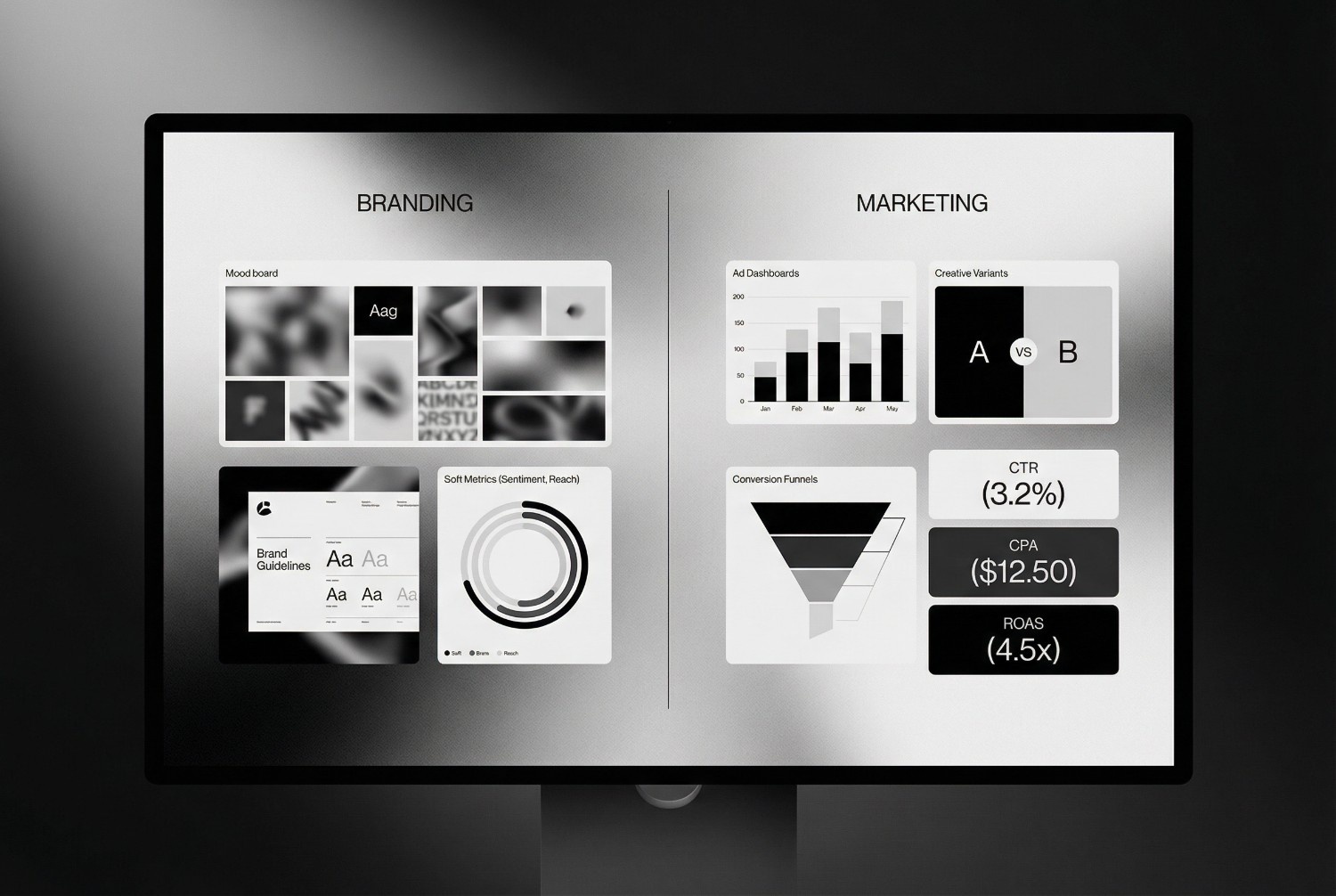
The goal is to sound right, look right, and stay on-brand across channels. Success is measured subjectively or with lagging indicators.
Typical characteristics:
- Long-lived assets like websites, blogs, brand campaigns
- One-to-many messaging
- Heavy reliance on guidelines and tone documents
- Feedback loops measured in months
- Success defined by approval, not performance
AI here is used to maintain consistency at scale. It replaces manual labor, not decision-making.
This is fine if your objective is coherence. It breaks down when you expect growth.
Branding AI answers the question:
Does this look like us?
It never answers:
Does this convert?
AI Content for Marketing: Optimized for Throughput and Signal
AI content for marketing operates under a different constraint.
Performance teams do not need perfect. They need volume, variation, and fast feedback.
Marketing AI is built around systems that generate, test, kill, and iterate creative continuously.
Typical characteristics:
- Short-lived assets like ads, hooks, angles, landing pages
- One-to-one or one-to-few messaging
- Minimal concern for perfection
- Feedback loops measured in days or hours
- Success defined by CPA, CTR, and revenue
Here, AI is not a creator. It is a multiplier inside a performance marketing funnel.
Marketing AI answers the only question that matters:
Does this make money at scale?
Why Most Brands Fail with AI Content
Most brands say they want performance, then run AI like a brand exercise.
Common failure modes:
- Generating a few AI ads and calling it a system
- Obsessing over tone instead of testing angles
- Producing content without a clear placement in the funnel
- Treating AI as a one-time efficiency win instead of ongoing infrastructure
This results in creative volume without learning. No learning means no scaling.
The System-Level Difference
The difference is not creative quality. It is system design.
Branding AI System
- Input: brand guidelines
- Output: polished content
- Feedback: subjective review
- Cadence: slow
- ROI visibility: low
Marketing AI System
- Input: performance data
- Output: creative variants
- Feedback: platform metrics
- Cadence: continuous
- ROI visibility: explicit
Only one of these compounds.
How Performance Teams Actually Use AI Content
High-performing teams use AI to remove the content bottleneck inside paid media.
A simple framework:
- AI generates 20–50 creative variations per angle
- Variants are deployed directly into ad platforms
- Performance data determines what survives
- Winning patterns feed the next generation of creative
This is creative production at scale, not content creation as a task.
For teams building this properly, content becomes a controllable input, not a constraint. [Internal link: Creative Systems]
Clear Takeaways for Operators
- Branding AI protects consistency. Marketing AI drives growth.
- One optimizes for approval. The other optimizes for feedback.
- AI only works when plugged into a system that learns.
- Content is the primary bottleneck to scaling paid ads.
- AI should replace manual processes, not strategic thinking.
If AI content is not directly tied to performance metrics, it is branding by default.
Where veilup Fits In
At veilup, AI is treated as infrastructure inside performance marketing systems.
The focus is not on making content faster. It is on making creative throughput predictable, measurable, and scalable across the entire funnel.
That distinction is why most brands stall and a few compound.
Optional next step: If your paid ads are constrained by creative volume, it is usually a systems problem, not a talent one.
More insights