


The 5 Klaviyo Flows Every Skincare Brand Needs (But Most Are Missing) in 2026

Most skincare brands obsess over CAC, Meta ROAS, and creative refresh cycles — and then ignore the single highest-leverage system in their entire stack. Email flows. Specifically, the automated Klaviyo flows that should be running quietly in the background, converting browsers into buyers and one-time customers into LTV-stacked loyalists.
The brutal reality in 2026: most skincare brands are operating with 1-2 flows live, sloppy logic, and copy written 18 months ago. That gap is bleeding 30%+ of potential LTV every single month. The brands winning this year are running five core flows — built specifically for skincare's repurchase cycle — and they are quietly outearning competitors who spend 3x more on paid.
The Problem: Skincare Flows Are Stuck in 2022
Walk into the Klaviyo account of the average sub-$10M skincare brand and you will see the same thing: a basic welcome series with three emails, a cart abandonment flow that fires once, and maybe a "thank you" post-purchase note that goes out the door and never gets touched again. That is it.
Meanwhile, Klaviyo's own benchmarks show that flow revenue should account for 25-35% of total email revenue for a healthy DTC skincare brand. Most accounts we audit are sitting at 8-12%. That delta — 20 points of revenue contribution — is the difference between profitable and unprofitable on a blended basis.
The issue is not Klaviyo. The platform is the most capable retention tool on the market. The issue is that flows have been treated as a "set it and forget it" task, and skincare specifically has a unique repurchase cadence (30-90 days depending on SKU) that demands flow logic built around replenishment, not generic ecommerce timing.
Why Flows Matter More Than Campaigns in 2026
Campaigns are loud. They are the newsletters, the launch announcements, the BFCM blasts that everyone celebrates. But campaigns are also unpredictable, dependent on copy quality, and capped by list size.
Flows are different. Flows are infrastructure. Once they are built correctly, they generate revenue automatically — every new subscriber, every browse session, every purchase triggers them. They scale linearly with traffic and they compound over time.
In a year when Meta CPMs are up another 14% YoY and TikTok Shop is fragmenting attention further, the brands that own their email retention infrastructure are the ones that get to keep their margins. Everything else is rented.
The 5 Klaviyo Flows Every Skincare Brand Needs in 2026
1. The Welcome Series (5-7 emails, not 3): Most welcome flows die at three emails. That is leaving 40%+ of welcome revenue on the table. The 2026 version is a 5-7 email sequence that introduces the brand story, educates on ingredients and skin science, offers a first-purchase incentive that escalates only if the subscriber does not convert, and segments by skin concern through a simple click-based question in email two. Brands running a properly built welcome flow see 18-25% of all email revenue come from this single series.
2. Browse Abandonment (the most underused flow in skincare): 95% of skincare brands have no browse abandonment flow live. This is insane, because the typical skincare shopper visits a product page 3-5 times before buying. Browse abandonment captures intent at the highest-friction moment — the research phase. A two-email flow triggered by viewed-product (with a 4-hour delay before the first send) consistently delivers $0.40-$0.80 per recipient, which is more than most welcome flows on a per-send basis.
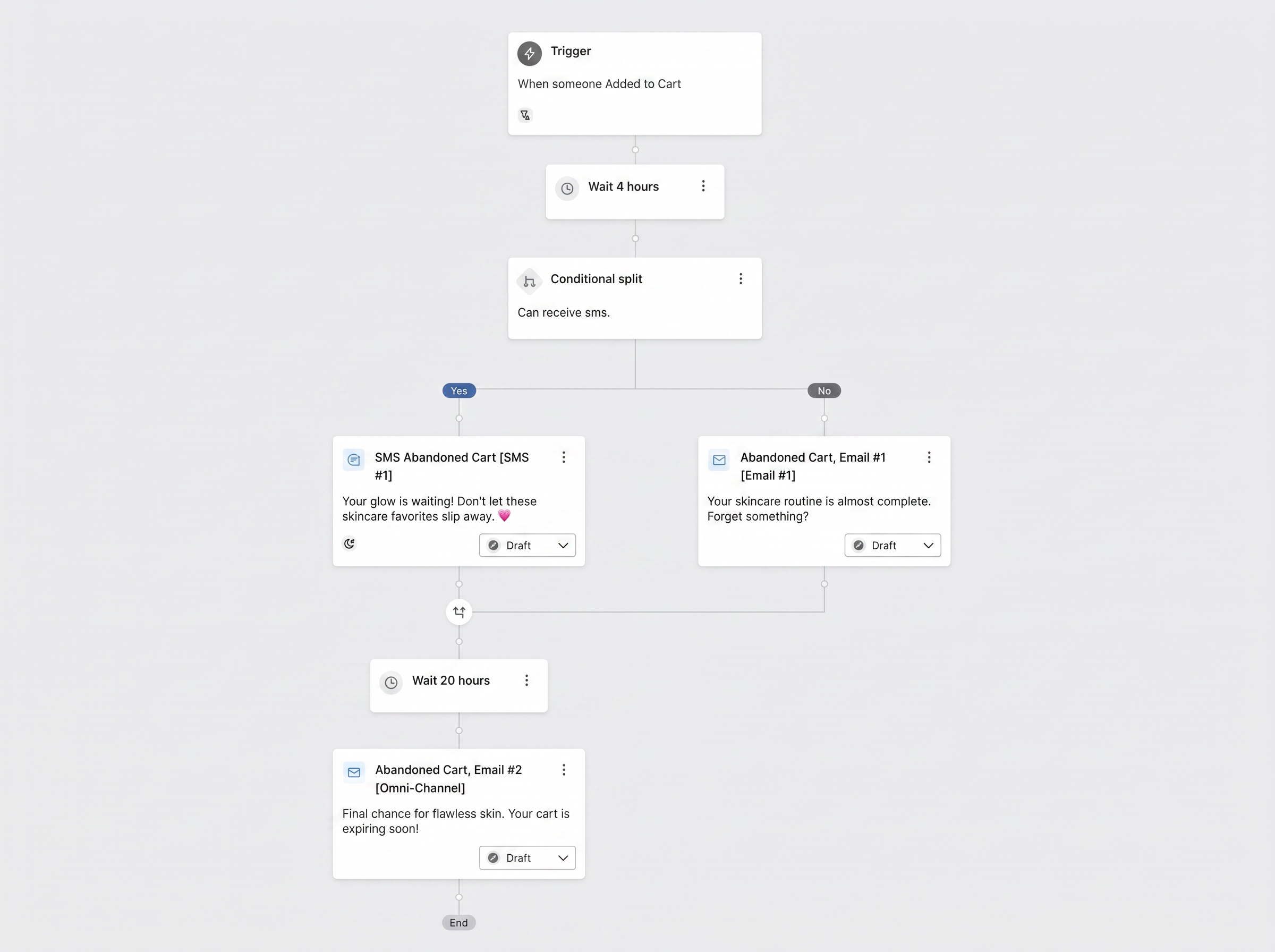
3. Cart Abandonment (3 emails, not 1): The single-email cart abandonment flow is dead. In 2026, the winning structure is three emails: a soft reminder at 1 hour (no discount), a value-based message at 24 hours focused on ingredient or routine fit, and a final urgency or incentive email at 48 hours. The 48-hour email is where the actual recovery happens. A properly tuned three-email cart abandonment recovers 8-12% of abandoned carts, versus 2-4% for single-email setups.
4. Post-Purchase Education + Replenishment (the LTV engine): This is the flow that separates brands doing $5M from brands doing $25M. The post-purchase sequence should include an order confirmation, a shipping update, a usage and education series timed to when the product is actually being used (day 3, day 7, day 14), a review request at day 21, and a replenishment trigger timed to the specific SKU's usage cycle (45 days for serums, 60-90 for moisturizers). Brands running a true post-purchase replenishment flow see reorder rates jump 25-40% within 90 days.
5. Win-Back (the silent revenue generator): Customers who have not purchased in 90-180 days are not gone — they are dormant. A win-back flow targeting customers at the 120-day mark with a personalized "we miss you" email, a curated product recommendation based on their first purchase, and an escalating incentive over a 14-day window reactivates dormant customers at 4-7% — and these reactivated customers have 2x the average order value of new customers because they have already passed the trust threshold.
The Skincare-Specific Logic Most Brands Miss
Generic ecommerce flow templates do not work for skincare. The category has unique dynamics that require specific tuning.
First, the repurchase window varies wildly by SKU. A 30ml serum is finished in 30-45 days. A 50ml moisturizer in 60-90. A cleanser in 90-120. Replenishment flows that fire on a generic 60-day trigger miss half the catalog. Tag every SKU with its usage cycle and trigger replenishment based on that.
Second, skin concerns drive everything. A customer who bought for acne is a completely different buyer from one who bought for hyperpigmentation. Welcome flows that segment by concern through a simple click-question and then dynamically populate product recommendations based on that segment outperform generic flows by 2-3x on conversion.
Third, routine-building is the upsell unlock. Skincare customers do not just buy products — they build routines. Post-purchase flows that introduce complementary products (a serum buyer gets educated on the moisturizer that pairs with it at day 14) drive 30-50% higher AOV on subsequent orders.
What to Build First
If you are starting from scratch — or rebuilding from a broken flow stack — start with the post-purchase replenishment flow. It is the highest-leverage flow because it targets customers who have already converted, who already trust the brand, and who are at their highest propensity to repurchase. Build it once and it pays back in 60 days.
From there, layer in the welcome flow (rebuilt to 5-7 emails with segmentation), then the three-email cart abandonment, then browse abandonment, then win-back. Do not try to build all five at once. Build them sequentially, A/B test each one, and only move to the next once the previous is converting at benchmark.
The brands winning in 2026 are not the brands with the biggest paid budgets. They are the brands with the most disciplined retention infrastructure. Flows are how that infrastructure gets built.
At Veilup, we help cosmetics and skincare brands implement Klaviyo flow architecture across their full marketing stack — from initial flow audit and skincare-specific segmentation to ongoing optimization and replenishment logic. If your brand is ready to stop leaving 30% of LTV on the table, the infrastructure is already here.
More insights